Work

Topics in this study will appear over time.

Showing posts with label Incorrect data. Show all posts

Monday, October 21, 2013

That Fiend in Hell: Soapy Smith's Denver reign in the Haigh dissertation.

Soapy Smith in front-page cartoon
(3rd from left at the table)


Rocky Mountain News, October 16, 1892
(Click image to enlarge)

In 2009 Jane G. Haigh completed her dissertation for a PhD in history and American Indian studies at the  University of Arizona. The title of her work is Political Power, Patronage, and Protection Rackets: Con Men and Political Corruption in Denver 1889-1894.

On page 8 of That Fiend in Hell, Cathy Spude incorrectly states that Jane Haigh

dispels the notion that Smith was influential in Denver politics, concluding that he was used by the Denver politicians as a tool to buy votes. 

Spude goes on to expand Haigh's supposed "conclusion" by stating that Soapy's "infamy" came from "the pleasure Denver newspapermen took in making fun of him—and by extension the candidates that he supported—than any real influence he had in Denver politics." Spude gives Haigh a general footnote credit, which cites no page(s), and adds how "This conclusion" should be taken into account in evaluating "Smith's overall legend."

I own a copy of Haigh's dissertation, have read it thoroughly and looked back through it numerous times. I found it well written and informative, but I also found that Haigh presents a very different history than the one of which Spude writes. Nowhere in the dissertation does Haigh indicate that Soapy was merely a tool, that Denver newspapermen took Soapy's reign lightly, or that they made fun of him. On the contrary, Haigh does write that "The most well known con man in Denver was Jefferson Randolph 'Soapy' Smith..." (p. 38). To demonstrate Soapy's prominence and degree of influence, Haigh quotes numerous newspaper accounts, such as this one published on July 29, 1889, in Denver's Rocky Mountain News: 

Soapy, in the language of the fly-by-night fraternity “has” Denver…. He has it to do with what he will in so far as all professional swindling and stealing is concerned…. The city is absolutely under the control of this prince of knaves, and there is not a confidence man, a sneak thief, or any other parasite upon the public who does not pursue his avocation under license from the man who has become great through the power vested in him by those whose sworn duty it is to administer the laws without fear or favor. (Dissertation, p. 77; also see more of this article in Alias Soapy Smith, pp. 145-46. The article includes this subtitle in capitals: "HE OWNS THE TOWN.")

Haigh adds the following:

Arkins [editor and owner of the Rocky Mountain News] was correct that in addition to his personal soap game and gambling, Soapy Smith had gained control of a downtown protection racket that exercised authority over the operations of thieves and con men, and paid off the police on behalf of all. Soapy developed this practice in Denver, perfected it in Creede, Colorado at the height of the brief silver rush, and later applied it to his advantage at Skagway, Alaska at the beginning of the Klondike Gold Rush.  (Dissertation, p. 77)

An examination of the dissertation shows that the "conclusion" Cathy Spude claims Jane Haigh draws does not belong to Haigh but to Spude and Spude alone.


Thursday, October 17, 2013

That Fiend in Hell: The deputy U.S. marshals of early Skagway.


On page 21 of her book, Cathy Spude states that U.S. Marshal John Shoup in Sitka appointed only one deputy to Dyea and Skagway, D. H. McInness, during the winter of 1897-98. The author then reasons that since McInness was stationed in Dyea and the only route to Skagway at the time was across four miles of often turbulent water, McInness probably asked for assistance from the vigilante organization in Skagway. Apparently the author forgot about the other deputy U.S. marshal assigned to Dyea and Skagway, James Mark Rowan. He was at first in Dyea with McInness but later established an office in Skagway and a home where he lived with his pregnant wife. He remained there until fatally shot in an ambush on January 31, 1898. Marshal Shoup in Sitka then appointed another deputy U.S. marshal to serve in Skagway, Sylvester S. Taylor. He remained stationed in Skagway until Shoup relieved him of duty in July 1898.


Tuesday, April 16, 2013

That Fiend in Hell: Not misunderstanding


I am happy to mark completion of the tenth post devoted to examining the book "That Fiend in Hell": Soapy Smith in Legend. I have taken time and care with these posts as each has required close and careful examination of the author's reasoning and conclusions.

Not Misunderstanding "That Fiend in Hell"

On her blog Cathy Spude writes,

The purpose of the book is to use the story of the last months of Smith's life, as it evolved after his death, to illustrate my understanding of how history, legend and myth intersect in modern American society. It is simply an exercise in the dissection of popular history.

… I was not interested in the details of history but the framework of the legend....

… My book is not about history. It is about myth and legend in modern American society….

Ever since my first comment regarding That Fiend in Hell, the author has insisted that I do not understand the purpose of her book. I do understand her statement of purpose. I also see many problems in her book that undercut that purpose. As I mark post #10 on this blog, I wonder if she can now understand why I have undertaken this blog. The reason for each posting is self-explanatory, and the accumulation of their type points to the general cause: the book contains a large accumulation of errors in fact and of interpretation.

To repeat, I absolutely understand her words as they are written above. Her book is not about history but about myth and legend, and yet she seems to want to revise history to justify her understanding of myth and legend. Looking into the exaggerated and fictional stories weaved into Soapy's life history is indeed interesting and even a little fun. However, I did not start and now continue this blog to examine those falsehoods and exaggerations. No, I began this blog because (1) I also found that many of the historical facts had been misinterpreted or interpreted so strangely as to merit examination, and on a personal note, because (2) there are discourteous accusations about my research and book that I seek to dispel.

Cathy Spude has also written that she believes I interpret "That Fiend in Hell" as a “personal affront” to my ancestor. Rather, in general, I interpret her work as an affront to history. While in various ways and in various sections of her book, she undeniably presents new information and apt interpretation, her book also contains many instances of error and strangely insistent and narrow interpretation. As a result, I have many more detailed points to publish before this blog is complete.

I hope you are enjoying the posts as much as I do in bringing them to you. While their cause is not so enjoyable, I find that the opportunity for close examination of topics is. My objective in conducting each of these examinations remains the same, to serve the goal of the Soapy Smith Preservation Trust: To preserve, promote, and expand a factual history of Jefferson Randolph "Soapy" Smith II. The purpose of Cathy Spude's book is often obscured by numerous factual and interpretive errors. These I do not misunderstand in the least and will continue to address them in the months and years ahead.


Friday, April 12, 2013

That Fiend in Hell: "Jeff Smith fails to mention," except that he did "mention"..., and a lot more about the murderer of Soapy Smith.

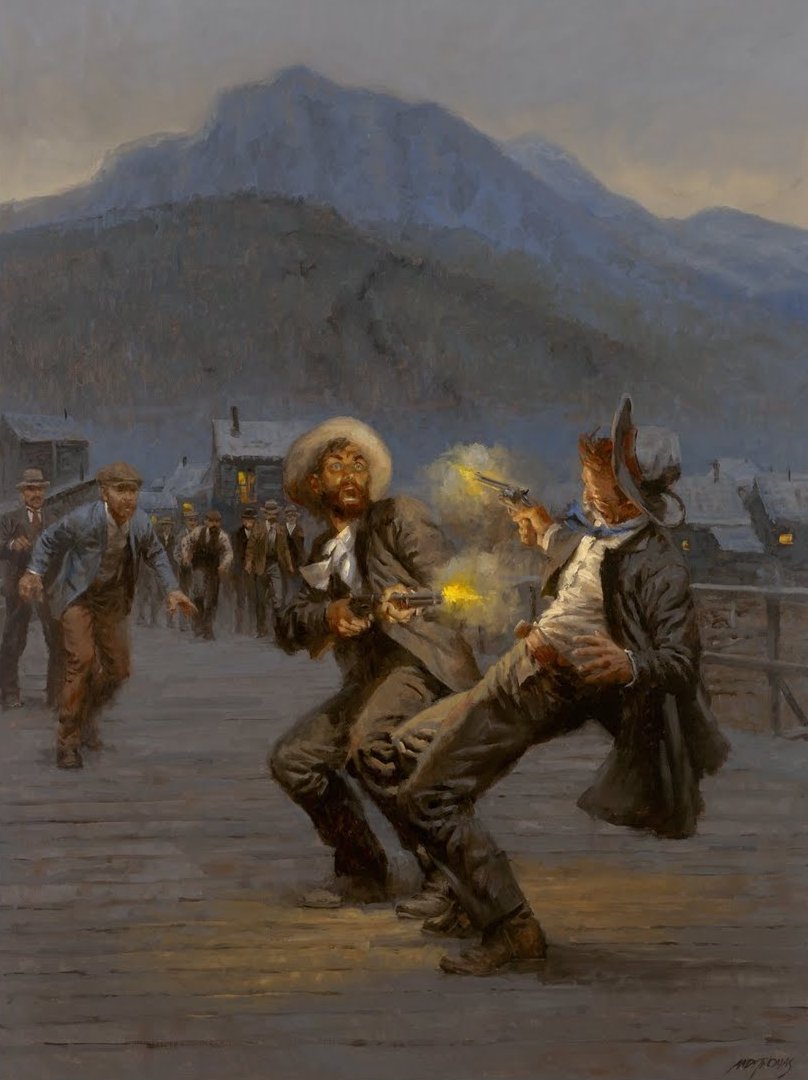
THE END OF SOAPY SMITH
The Shootout on Juneau Wharf
Smith and Reid shoot one another as Jesse Murphy (left)
rushes in to aid Reid. Murphy kills Smith with Smith's rifle.
Artist Andy Thomas worked closely with Jeff Smith to get the details precise.
(Courtesy of Andy Thomas)
(Click image to enlarge)


On pages 192-93 of "That Fiend in Hell," author Cathy Spude offers an example of how I make an "effort to convince … readers that Jesse Murphy 'murdered Soapy'…." She points to a news report that I cite in the July 19, 1898, issue of the Portland Morning Oregonian and asserts that I cite only the portion of the sentence that serves my point (that Murphy claimed to have killed Soapy Smith) and that I purposely left out the rest because it disputes my point. To make her case about the omission from the Portland paper, she uses phrases like "Jeff Smith fails to mention" and "he fails to point out."

This is indeed a very strange quibble because I did quote the entire sentence. In fact, I quote not just the entire sentence but the entire paragraph in which the sentence appears. The matter is made even stranger because to document her accusation, she cites the numbers of three surrounding pages on which discussion of the matter appears, but she fails to list the page on which appears the entire sentence and paragraph from the Portland Morning Oregonian. Here for clarity is that paragraph as it appears on page 548 of Alias Soapy Smith.

The shooting, Dr. Cornelius says, is the best thing that ever happened to Skagway next to the new railroad. Dr. Cornelius performed the autopsy on Smith’s body for the coroner’s jury. A man named Murphy claimed after the first autopsy that it was his bullet that killed the gambler, and it was necessary to perform a second [autopsy] to determine that Reed’s [sic] bullet did the work.

I would like to think that the author of "That Fiend in Hell" just made a mistake. Mistakes happen. I even made one once … perhaps two. But Cathy Spude takes such a heavy handed approach that it seems there is much more than a mistake at work in her thinking. In writing that "Jeff Smith fails to mention" and "fails to point out," she does not imply but rather outright accuses me of intentionally leaving out text in order to "justify" a conclusion. I cannot know what was in Cathy Spude's mind, but the stern, accusatory tone of her language does make itself known and felt as she apparently intended. Then in light of how her example is in complete error, revealed is not just a mistake or careless inattention to detail but a deep and determined bias against my biography of Soapy Smith. I am at a loss for any other way to explain such a focused indictment based on an error of her own making.

Cathy Spude in her criticism of my treatment of Soapy's death and the cover up that followed would have a reader believe my conclusion is based on half a sentence rather than the 23 pages of evidence and interpretation that appear in chapters 25 and 26 of Alias Soapy Smith (pages 538-561). I took much time and care in laying out the evidence, evaluating it, and drawing reasoned conclusions about it. To my knowledge, nothing has been omitted or obscured.

The story of the murder of Soapy Smith has just appeared in a feature-length article I was invited to write for Wild West magazine (April 2013, pages 44-51). It's a nice spread, with many illustrations. Though a feature piece, its space requirements called for compression, so only the most pertinent facts and the overall conclusion appear. For the full story, my book is the ultimate source for a survey of all known evidence and an even-handed examination of it.

Cathy Spude on page 193 of her book also claims that Jeff Smith lacks "understanding of [the] historic context" of Skagway in 1898. Probably no one will be surprised to learn that Jeff Smith disagrees. For three decades I have studied the players of this period and the details of their doings. I know this context extremely well; I just don't follow Cathy Spude's interpretations of people or events. Each of these disagreements, as well as correction of errors—one at a time—will make good reading for other days.


Monday, April 8, 2013

That Fiend In Hell: Research for Alias Soapy Smith was unscholarly and lazy?


Throughout That Fiend in Hell, author Cathy Spude assails my research as unscholarly and at times implies that I was lazy in its conduct. Emphasized is the assumption that the bulk of my research was performed online, but as explained in the preface of my book, that was far from the case. Newspaper research was especially difficult in 1985 when I began the task as there were no online collections that allowed one simply to open a screen and type in a key search word. My early research took me to numerous libraries, archives, and museums in Alaska, Colorado, and Washington to view microfilm unavailable through inter-library loan. On page 192 of her book, Spude assumes and implies that I accessed Alaska newspapers online, but as she researched the same Alaska newspapers I did, she is fully aware that, even now, these newspapers are not available online. Further, she assumes I accessed other sources for quotation from these newspapers. This is not the case. Every quotation in my book that is from Alaska newspapers in Skagway for 1897-98 comes from photocopies in my possession from library-held microfilm of those newspapers, cranked through a "reader" page by page.

In my home state I ordered microfilm rolls, one at a time, for two decades. As microfilm has no search capability or index, thousands of hours were invested in scouring each of the many reels, reading page-by-page, day-by-day, year-by-year, researching my subject and those in his circle in newspapers of that time and place. I was extremely successful in finding and publishing information that otherwise might never have been uncovered and explored because much of it lay buried until I found it, assembled it, gave it interpretive context, and published it in 2009. "Reading upwards of 90,000 pages took years. It was a daunting task but proved a goldmine of information not known to have been republished anywhere...." (Alias Soapy Smith p. 6).


Tuesday, January 8, 2013

That Fiend in Hell: Soapy Smith thrown out of Skagway?

Broadway and Bond (Fourth)
Skaguay, Alaska
August 11, 1897
The way the camp looked when Soapy Smith arrived.
Courtesy of eBay
(Click image to enlarge)


On page 22 and again on page 30 of That Fiend in Hell, the author Cathy Spude causally mentions that in September 1897 a Denver newspaper states how the people of Skagway, Alaska, ran Soapy Smith out of town. She adds that Soapy traveled to St. Louis, Washington, D.C., and New York City, but skips over his first stop in Seattle, Washington, during which time his great success in Skagway was disclosed.

Soapy Smith was not forced to leave Skagway. Rather, he left for personal reasons all his own. The whole story is interesting, and I’d like to share it with you.

Let's begin by backing up from September 1897 to mid August, when from Seattle, Soapy Smith and two other confidence men, Jack Jolly and Jerry Daily, traveled by steamship to Skagway. They arrived in the 27-day-old camp on Sunday, August 22, 1897. The three men worked their swindles for 19 of 23 days and in that time made $30,000 and divided it before returning to Seattle (–Alias Soapy Smith, p. 435, Denver Evening Post 11/15/1897). 

Jeff hated the Alaska winter and would have preferred to spend it down in the states (–Alias Soapy Smith, p. 442). With business so good, though, he would endure the wind, rain, snow, and cold. Something else, however, made Soapy leave Skagway while his operations were so successful: his wife Mary. Receiving word that she was ill, Soapy boarded the SS Queen for Seattle on September 14, 1897, and docked there eight days later (–Alias Soapy Smith, p. 435). The Seattle Daily Times interviewed passengers returning from Alaska, and Soapy was one of them. In his interview he claimed to have earned $18,000 to $20,000 during his short stay in Skagway, amounts equivalent today to over $600,000 (–Alias Soapy Smith, p.442,  Seattle Daily Times 9/23/1897).

Also aboard the Queen with Soapy (who was accompanied by Daily and Jolly) were US Attorney Bennett and US Marshal James McCain Shoup. They claimed that Skagway residents forced Soapy out of Alaska (–Alias Soapy Smith, p. 442, Denver Evening Post 9/23/1897), but this was not true. In Seattle "Bat" Masterson spoke with Jerry Daily and later reported to the Denver Evening Post what he (Masterson) learned about Soapy’s time in Skagway and departure from there.   

I saw very few people from Denver. I heard of but did not see Soapy Smith. The report that he was driven out of Skaguay was erroneous. I met his partner Jerry Daily, at Spokane. He said they were in Skaguay twenty-three days and ‘worked’ nineteen days while there. During the nineteen days they captured $30,000, which was divided into four parts, over $7,000 each, but Soapy got the most of it ultimately. He received a telegram that his wife was sick in St. Louis and went to that city to be with her. They did not have time to bother with him at Skaguay, for everybody was too busy looking out for themselves. (–Alias Soapy Smith, p. 443, Denver Evening Post 11/15/1897) 

Four months later, on January 21, 1898, the Skaguay News reported Soapy’s return. If Soapy had been run out of town, he would have encountered resistance to his return and settling in to stay. But no such difficulty is in evidence. Seven days later M. H. Craig reported to the Denver Evening Post that Soapy was working the shell game along the trails (–Denver Evening Post 1/28/1898). Soapy’s supposed deportation from Skagway was never reported in Skagway and never brought up again.