Work

Topics in this study will appear over time.

Showing posts with label Alias Soapy Smith. Show all posts

Friday, May 24, 2013

That Fiend in Hell: On good and not-so-good comments.

M. J. Kirchhoff's new book


A difference is apparent between the book review comments made by those who have not researched Soapy Smith and those who have.

Cathy Spude's website contains seven comments about That Fiend in Hell by various writers, researchers, and publishers. Of these, only William H. Hunt is known to have published anything about Soapy Smith in Alaska (Chapter 5, "Vigilantes," Distant Justice: Policing the Alaskan Frontier, 1987). Unfortunately, Hunt's 16-page chapter contains the common, erroneous information put forth by previous authors who were willing to pass along hearsay and fiction about Soapy Smith. My aim in addressing this matter is not to belittle those who have written so glowingly of Cathy Spude's book but to point out that these writers have not been serious researchers about the life of Soapy Smith and his immediate environment. For this reason, their glowing comments about That Fiend in Hell tend more toward friendly flattery than authoritative comment.

The exception is William H. Hunt. He points to himself as one who made errors in representation and who learned from Cathy Spude's book. Subsequently he also read my biography and wrote that he appreciated my research and its presentation (see comment, top right column).

A contrast to the statements addressed above about That Fiend in Hell comes from M. J. Kirchoff, twice named Alaska Historian of the Year and author of the new book Dyea, Alaska. It appears in Skagway Stories, a blog devoted to the history and people of Skagway, Alaska. Provided below is this blog post in full, with Mr. Kirchoff's "comment" emphasized.

Yesterday I attended a lecture at the National Park Service by M. J. Kirchhoff on violence on the trails and the Soapy story. There was also a critical review of Spude’s book which many agreed had many false assumptions and mistakes. Mark agreed that Jeff Smith’s book on Soapy is a very good reference for students and historians.

Mark’s new book is called Dyea, Alaska: The Rise and Fall of a Klondike Gold Rush Town, printed in 2012 and available at the Skagway News Depot in Skagway. I leafed through it and was amazed at the incredible collection of historic photos of Dyea that have never been published before. Also at their clarity and good descriptions. Here is Michael Gates description: 'Kirchhoff is a widely respected historian whose previous works include an excellent biography of Jack Dalton as well as Clondyke: The First Year of the Rush… Kirchhoff tackles the overlooked aspects of Alaska and Yukon history and fills in the gaps in our understanding of the North…. Kirchhoff’s book charts the rapid decline of Dyea, and offers an explanation for the eventual death of this once bustling community, but you will have to read the book to learn the answer....
All writers and researchers appreciate friendly comments about their work and tend to publish them in promotions. Sometimes, though, the comments seem not so friendly, and the best of these are the ones that point out the good and the not so good, such as mistakes or perceived failings. When only the comments of those less than fully qualified are presented, all highly flattering, the effect tends more toward puffery than honest comment. In the pursuit of truth, good can come from comments that also find fault. They help to adjust a work and make better work possible.

I guess it all boils down to this: when a work is published, its life is not over. It keeps on living the life that has been given it by its creator. Glowing comments from those not so qualified to evaluate do not establish or preserve the quality of a work. Only its ability to present truths that last over time can do that.


Tuesday, April 16, 2013

That Fiend in Hell: Not misunderstanding


I am happy to mark completion of the tenth post devoted to examining the book "That Fiend in Hell": Soapy Smith in Legend. I have taken time and care with these posts as each has required close and careful examination of the author's reasoning and conclusions.

Not Misunderstanding "That Fiend in Hell"

On her blog Cathy Spude writes,

The purpose of the book is to use the story of the last months of Smith's life, as it evolved after his death, to illustrate my understanding of how history, legend and myth intersect in modern American society. It is simply an exercise in the dissection of popular history.

… I was not interested in the details of history but the framework of the legend....

… My book is not about history. It is about myth and legend in modern American society….

Ever since my first comment regarding That Fiend in Hell, the author has insisted that I do not understand the purpose of her book. I do understand her statement of purpose. I also see many problems in her book that undercut that purpose. As I mark post #10 on this blog, I wonder if she can now understand why I have undertaken this blog. The reason for each posting is self-explanatory, and the accumulation of their type points to the general cause: the book contains a large accumulation of errors in fact and of interpretation.

To repeat, I absolutely understand her words as they are written above. Her book is not about history but about myth and legend, and yet she seems to want to revise history to justify her understanding of myth and legend. Looking into the exaggerated and fictional stories weaved into Soapy's life history is indeed interesting and even a little fun. However, I did not start and now continue this blog to examine those falsehoods and exaggerations. No, I began this blog because (1) I also found that many of the historical facts had been misinterpreted or interpreted so strangely as to merit examination, and on a personal note, because (2) there are discourteous accusations about my research and book that I seek to dispel.

Cathy Spude has also written that she believes I interpret "That Fiend in Hell" as a “personal affront” to my ancestor. Rather, in general, I interpret her work as an affront to history. While in various ways and in various sections of her book, she undeniably presents new information and apt interpretation, her book also contains many instances of error and strangely insistent and narrow interpretation. As a result, I have many more detailed points to publish before this blog is complete.

I hope you are enjoying the posts as much as I do in bringing them to you. While their cause is not so enjoyable, I find that the opportunity for close examination of topics is. My objective in conducting each of these examinations remains the same, to serve the goal of the Soapy Smith Preservation Trust: To preserve, promote, and expand a factual history of Jefferson Randolph "Soapy" Smith II. The purpose of Cathy Spude's book is often obscured by numerous factual and interpretive errors. These I do not misunderstand in the least and will continue to address them in the months and years ahead.


Friday, April 12, 2013

That Fiend in Hell: "Jeff Smith fails to mention," except that he did "mention"..., and a lot more about the murderer of Soapy Smith.

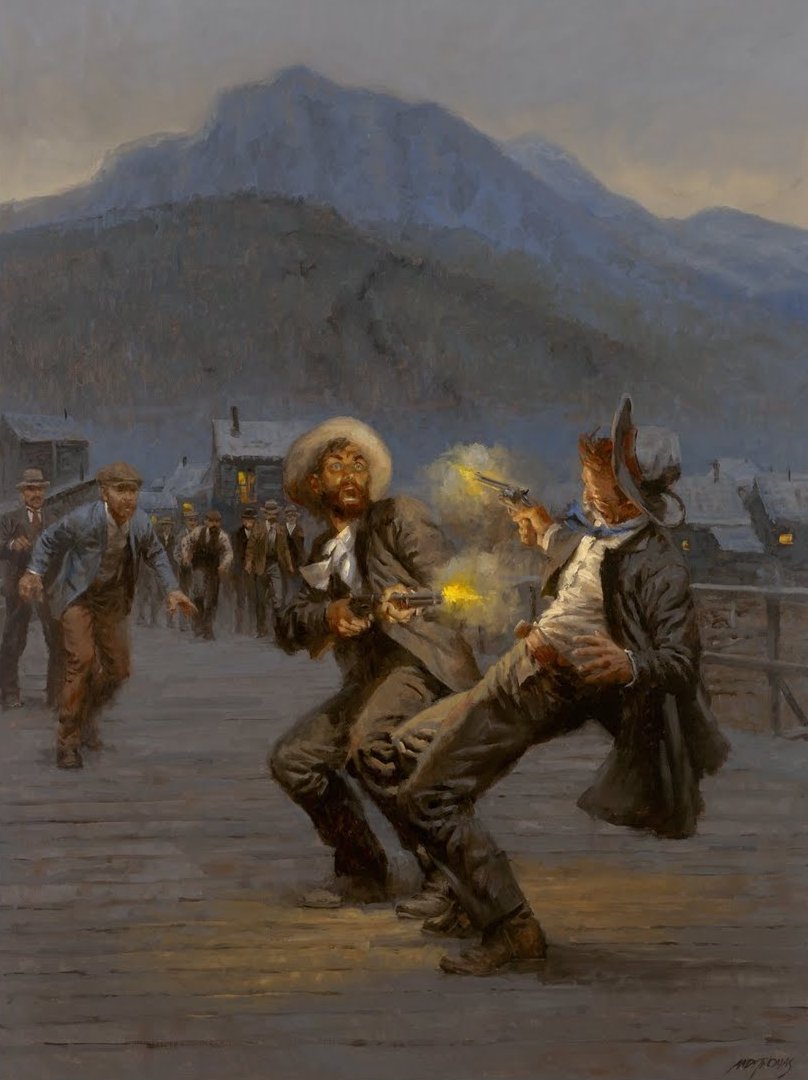
THE END OF SOAPY SMITH
The Shootout on Juneau Wharf
Smith and Reid shoot one another as Jesse Murphy (left)
rushes in to aid Reid. Murphy kills Smith with Smith's rifle.
Artist Andy Thomas worked closely with Jeff Smith to get the details precise.
(Courtesy of Andy Thomas)
(Click image to enlarge)


On pages 192-93 of "That Fiend in Hell," author Cathy Spude offers an example of how I make an "effort to convince … readers that Jesse Murphy 'murdered Soapy'…." She points to a news report that I cite in the July 19, 1898, issue of the Portland Morning Oregonian and asserts that I cite only the portion of the sentence that serves my point (that Murphy claimed to have killed Soapy Smith) and that I purposely left out the rest because it disputes my point. To make her case about the omission from the Portland paper, she uses phrases like "Jeff Smith fails to mention" and "he fails to point out."

This is indeed a very strange quibble because I did quote the entire sentence. In fact, I quote not just the entire sentence but the entire paragraph in which the sentence appears. The matter is made even stranger because to document her accusation, she cites the numbers of three surrounding pages on which discussion of the matter appears, but she fails to list the page on which appears the entire sentence and paragraph from the Portland Morning Oregonian. Here for clarity is that paragraph as it appears on page 548 of Alias Soapy Smith.

The shooting, Dr. Cornelius says, is the best thing that ever happened to Skagway next to the new railroad. Dr. Cornelius performed the autopsy on Smith’s body for the coroner’s jury. A man named Murphy claimed after the first autopsy that it was his bullet that killed the gambler, and it was necessary to perform a second [autopsy] to determine that Reed’s [sic] bullet did the work.

I would like to think that the author of "That Fiend in Hell" just made a mistake. Mistakes happen. I even made one once … perhaps two. But Cathy Spude takes such a heavy handed approach that it seems there is much more than a mistake at work in her thinking. In writing that "Jeff Smith fails to mention" and "fails to point out," she does not imply but rather outright accuses me of intentionally leaving out text in order to "justify" a conclusion. I cannot know what was in Cathy Spude's mind, but the stern, accusatory tone of her language does make itself known and felt as she apparently intended. Then in light of how her example is in complete error, revealed is not just a mistake or careless inattention to detail but a deep and determined bias against my biography of Soapy Smith. I am at a loss for any other way to explain such a focused indictment based on an error of her own making.

Cathy Spude in her criticism of my treatment of Soapy's death and the cover up that followed would have a reader believe my conclusion is based on half a sentence rather than the 23 pages of evidence and interpretation that appear in chapters 25 and 26 of Alias Soapy Smith (pages 538-561). I took much time and care in laying out the evidence, evaluating it, and drawing reasoned conclusions about it. To my knowledge, nothing has been omitted or obscured.

The story of the murder of Soapy Smith has just appeared in a feature-length article I was invited to write for Wild West magazine (April 2013, pages 44-51). It's a nice spread, with many illustrations. Though a feature piece, its space requirements called for compression, so only the most pertinent facts and the overall conclusion appear. For the full story, my book is the ultimate source for a survey of all known evidence and an even-handed examination of it.

Cathy Spude on page 193 of her book also claims that Jeff Smith lacks "understanding of [the] historic context" of Skagway in 1898. Probably no one will be surprised to learn that Jeff Smith disagrees. For three decades I have studied the players of this period and the details of their doings. I know this context extremely well; I just don't follow Cathy Spude's interpretations of people or events. Each of these disagreements, as well as correction of errors—one at a time—will make good reading for other days.


Monday, April 8, 2013

That Fiend In Hell: Research for Alias Soapy Smith was unscholarly and lazy?


Throughout That Fiend in Hell, author Cathy Spude assails my research as unscholarly and at times implies that I was lazy in its conduct. Emphasized is the assumption that the bulk of my research was performed online, but as explained in the preface of my book, that was far from the case. Newspaper research was especially difficult in 1985 when I began the task as there were no online collections that allowed one simply to open a screen and type in a key search word. My early research took me to numerous libraries, archives, and museums in Alaska, Colorado, and Washington to view microfilm unavailable through inter-library loan. On page 192 of her book, Spude assumes and implies that I accessed Alaska newspapers online, but as she researched the same Alaska newspapers I did, she is fully aware that, even now, these newspapers are not available online. Further, she assumes I accessed other sources for quotation from these newspapers. This is not the case. Every quotation in my book that is from Alaska newspapers in Skagway for 1897-98 comes from photocopies in my possession from library-held microfilm of those newspapers, cranked through a "reader" page by page.

In my home state I ordered microfilm rolls, one at a time, for two decades. As microfilm has no search capability or index, thousands of hours were invested in scouring each of the many reels, reading page-by-page, day-by-day, year-by-year, researching my subject and those in his circle in newspapers of that time and place. I was extremely successful in finding and publishing information that otherwise might never have been uncovered and explored because much of it lay buried until I found it, assembled it, gave it interpretive context, and published it in 2009. "Reading upwards of 90,000 pages took years. It was a daunting task but proved a goldmine of information not known to have been republished anywhere...." (Alias Soapy Smith p. 6).


Friday, March 1, 2013

That Fiend in Hell: Unscholarly and biased?

Demand Evidence - Think Critically
I made this inspiring poster long ago for myself

(Click image to enlarge)


Throughout That Fiend in Hell, author Cathy Spude assails my research as unscholarly and biased. On page 191 the author writes,
As is evident from Jeff Smith’s biography, these stories no doubt emphasized Soapy’s good works and were soft on the more cruel or iniquitous aspects of the gambler’s behavior. 
It is such comments that make me continue to question if she has even read my book. The fact is, as of 2009 Alias Soapy Smith includes all known “… cruel or iniquitous aspects of the gambler’s behavior.” 

I began writing Alias Soapy Smith over 25-years ago with the full intent of not publishing a biased or white-washed biography. In handing over my manuscript to my publisher at Klondike Research, I required that he check for any evidence of bias or white wash. He did so, and in turn, he tasked his staff with the same chore along with their regular duties. A few questionable instances were found, brought to my attention, and revised by me to achieve a balanced presentation based on evidence available to me at the time. The following comes from the book preface. 
It is important to me for the reader to understand that although I am related to the subject of this book, I do not pretend to believe Soapy was “a good guy” or someone to be admired. I would be untruthful were I to say it is not fun being a descendant of an Old West bad man. The little moments of celebrity are enjoyed. But my primary interest has been the history of Soapy Smith. I am not proud of what he did but rather of what he left behind, an outsized history of a complex character at the center of often rough frontier times. No attempt has been made to mask his crimes. As my father used to tell me, “Jeff, he’s more interesting that way,” how he really was—his charities, crimes, all. (—Alias Soapy Smith, p. 5)


Wednesday, December 5, 2012

That Fiend in Hell: Alias Soapy Smith not good enough?


On page 8 of That Fiend In Hell, the author states that “only three professional historians have attempted to examine the Smith story within some context other than that of an adventure.”

These three works are as follows:

  1. Bearss, Edwin C. Proposed Klondike Gold Rush National Historical Park Historic Resource Study. Washington, D.C.: U.S. Department of the Interior, 1970. Pages 181-97, 16 pages relate to Soapy Smith. Cathy Spude says that Bearss relies on Pierre Berton’s work, which she feels is not reliable.

  2. Hunt, William R. Distant Justice: Policing the Alaskan Frontier. Norman: University of Oklahoma Press, 1987. The section on Soapy, pages 52-67, is only 15 pages, and Cathy Spude states that Hunt's treatment lacks focus on Smith because it is narrowed to vigilantism in 1898 Skagway.

  3. Haigh, Jane G. "Political Power, Patronage, and Protection Rackets: Con Men and Political Corruption in Denver, 1889-1894." Unpublished PhD Dissertation, University of Arizona, 2009. With little discussion and no documentation, Cathy Spude claims this work shows that Soapy Smith had little influence on Denver politics.

In her Introduction, these are the only scholarly treatments of Soapy Smith that Cathy Spude found worthy of mention. Apparently she forgot the 628-page biography titled Alias Soapy Smith, which she reviewed two years before and about which in part she wrote, "the book is well-cited, with numerous footnotes and a detailed index" (Alaska History Vol. 25, No. 2, Fall 2010, p. 57). Shouldn't this comprehensive, carefully researched, fully documented, critical treatment of "the Smith Story" receive a mention with those others? It would seem so especially since the author finds fault with two of them for not questioning and for lacking focus on the Smith story. What seems to be the case is that Cathy Spude intentionally omitted mention of the comprehensive, critical biography because its author is not classified by Cathy Spude as a "professional historian," as if only one with such a title bestowed by her is capable of producing factual works.

In writing about the history of the Old West, author and historian Paul Cool observes that “… the grassroots historian probably has been responsible for much, if not most of the discoveries of the past 35 or more years concerning the details of the lives, acts of violence, and deaths of such men (and occasional women), and of the many men and women who were witness to or wrapped up in their stories” (http://www.paulcoolbooks.com/?p=231, 6 Jun 2012, accessed 5 Dec 2012).

Surely the "professionals" are not the only ones to have developed sufficient historical background, skill, and discipline to find evidence, categorize it, measure it, question it, and present it in a published form that may be considered "scholarly" and be reasonably termed "history."