Work

Topics in this study will appear over time.

Tuesday, April 16, 2013

That Fiend in Hell: Not misunderstanding


I am happy to mark completion of the tenth post devoted to examining the book "That Fiend in Hell": Soapy Smith in Legend. I have taken time and care with these posts as each has required close and careful examination of the author's reasoning and conclusions.

Not Misunderstanding "That Fiend in Hell"

On her blog Cathy Spude writes,

The purpose of the book is to use the story of the last months of Smith's life, as it evolved after his death, to illustrate my understanding of how history, legend and myth intersect in modern American society. It is simply an exercise in the dissection of popular history.

… I was not interested in the details of history but the framework of the legend....

… My book is not about history. It is about myth and legend in modern American society….

Ever since my first comment regarding That Fiend in Hell, the author has insisted that I do not understand the purpose of her book. I do understand her statement of purpose. I also see many problems in her book that undercut that purpose. As I mark post #10 on this blog, I wonder if she can now understand why I have undertaken this blog. The reason for each posting is self-explanatory, and the accumulation of their type points to the general cause: the book contains a large accumulation of errors in fact and of interpretation.

To repeat, I absolutely understand her words as they are written above. Her book is not about history but about myth and legend, and yet she seems to want to revise history to justify her understanding of myth and legend. Looking into the exaggerated and fictional stories weaved into Soapy's life history is indeed interesting and even a little fun. However, I did not start and now continue this blog to examine those falsehoods and exaggerations. No, I began this blog because (1) I also found that many of the historical facts had been misinterpreted or interpreted so strangely as to merit examination, and on a personal note, because (2) there are discourteous accusations about my research and book that I seek to dispel.

Cathy Spude has also written that she believes I interpret "That Fiend in Hell" as a “personal affront” to my ancestor. Rather, in general, I interpret her work as an affront to history. While in various ways and in various sections of her book, she undeniably presents new information and apt interpretation, her book also contains many instances of error and strangely insistent and narrow interpretation. As a result, I have many more detailed points to publish before this blog is complete.

I hope you are enjoying the posts as much as I do in bringing them to you. While their cause is not so enjoyable, I find that the opportunity for close examination of topics is. My objective in conducting each of these examinations remains the same, to serve the goal of the Soapy Smith Preservation Trust: To preserve, promote, and expand a factual history of Jefferson Randolph "Soapy" Smith II. The purpose of Cathy Spude's book is often obscured by numerous factual and interpretive errors. These I do not misunderstand in the least and will continue to address them in the months and years ahead.


Friday, April 12, 2013

That Fiend in Hell: "Jeff Smith fails to mention," except that he did "mention"..., and a lot more about the murderer of Soapy Smith.

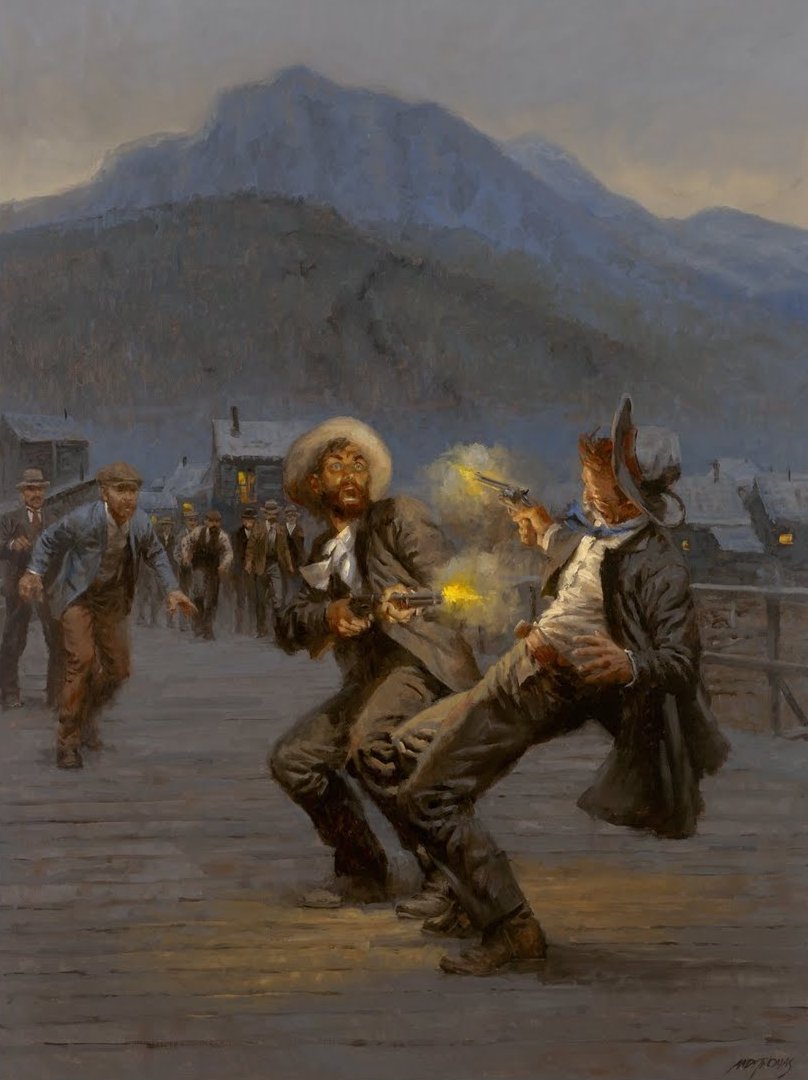
THE END OF SOAPY SMITH
The Shootout on Juneau Wharf
Smith and Reid shoot one another as Jesse Murphy (left)
rushes in to aid Reid. Murphy kills Smith with Smith's rifle.
Artist Andy Thomas worked closely with Jeff Smith to get the details precise.
(Courtesy of Andy Thomas)
(Click image to enlarge)


On pages 192-93 of "That Fiend in Hell," author Cathy Spude offers an example of how I make an "effort to convince … readers that Jesse Murphy 'murdered Soapy'…." She points to a news report that I cite in the July 19, 1898, issue of the Portland Morning Oregonian and asserts that I cite only the portion of the sentence that serves my point (that Murphy claimed to have killed Soapy Smith) and that I purposely left out the rest because it disputes my point. To make her case about the omission from the Portland paper, she uses phrases like "Jeff Smith fails to mention" and "he fails to point out."

This is indeed a very strange quibble because I did quote the entire sentence. In fact, I quote not just the entire sentence but the entire paragraph in which the sentence appears. The matter is made even stranger because to document her accusation, she cites the numbers of three surrounding pages on which discussion of the matter appears, but she fails to list the page on which appears the entire sentence and paragraph from the Portland Morning Oregonian. Here for clarity is that paragraph as it appears on page 548 of Alias Soapy Smith.

The shooting, Dr. Cornelius says, is the best thing that ever happened to Skagway next to the new railroad. Dr. Cornelius performed the autopsy on Smith’s body for the coroner’s jury. A man named Murphy claimed after the first autopsy that it was his bullet that killed the gambler, and it was necessary to perform a second [autopsy] to determine that Reed’s [sic] bullet did the work.

I would like to think that the author of "That Fiend in Hell" just made a mistake. Mistakes happen. I even made one once … perhaps two. But Cathy Spude takes such a heavy handed approach that it seems there is much more than a mistake at work in her thinking. In writing that "Jeff Smith fails to mention" and "fails to point out," she does not imply but rather outright accuses me of intentionally leaving out text in order to "justify" a conclusion. I cannot know what was in Cathy Spude's mind, but the stern, accusatory tone of her language does make itself known and felt as she apparently intended. Then in light of how her example is in complete error, revealed is not just a mistake or careless inattention to detail but a deep and determined bias against my biography of Soapy Smith. I am at a loss for any other way to explain such a focused indictment based on an error of her own making.

Cathy Spude in her criticism of my treatment of Soapy's death and the cover up that followed would have a reader believe my conclusion is based on half a sentence rather than the 23 pages of evidence and interpretation that appear in chapters 25 and 26 of Alias Soapy Smith (pages 538-561). I took much time and care in laying out the evidence, evaluating it, and drawing reasoned conclusions about it. To my knowledge, nothing has been omitted or obscured.

The story of the murder of Soapy Smith has just appeared in a feature-length article I was invited to write for Wild West magazine (April 2013, pages 44-51). It's a nice spread, with many illustrations. Though a feature piece, its space requirements called for compression, so only the most pertinent facts and the overall conclusion appear. For the full story, my book is the ultimate source for a survey of all known evidence and an even-handed examination of it.

Cathy Spude on page 193 of her book also claims that Jeff Smith lacks "understanding of [the] historic context" of Skagway in 1898. Probably no one will be surprised to learn that Jeff Smith disagrees. For three decades I have studied the players of this period and the details of their doings. I know this context extremely well; I just don't follow Cathy Spude's interpretations of people or events. Each of these disagreements, as well as correction of errors—one at a time—will make good reading for other days.


Monday, April 8, 2013

That Fiend In Hell: Research for Alias Soapy Smith was unscholarly and lazy?


Throughout That Fiend in Hell, author Cathy Spude assails my research as unscholarly and at times implies that I was lazy in its conduct. Emphasized is the assumption that the bulk of my research was performed online, but as explained in the preface of my book, that was far from the case. Newspaper research was especially difficult in 1985 when I began the task as there were no online collections that allowed one simply to open a screen and type in a key search word. My early research took me to numerous libraries, archives, and museums in Alaska, Colorado, and Washington to view microfilm unavailable through inter-library loan. On page 192 of her book, Spude assumes and implies that I accessed Alaska newspapers online, but as she researched the same Alaska newspapers I did, she is fully aware that, even now, these newspapers are not available online. Further, she assumes I accessed other sources for quotation from these newspapers. This is not the case. Every quotation in my book that is from Alaska newspapers in Skagway for 1897-98 comes from photocopies in my possession from library-held microfilm of those newspapers, cranked through a "reader" page by page.

In my home state I ordered microfilm rolls, one at a time, for two decades. As microfilm has no search capability or index, thousands of hours were invested in scouring each of the many reels, reading page-by-page, day-by-day, year-by-year, researching my subject and those in his circle in newspapers of that time and place. I was extremely successful in finding and publishing information that otherwise might never have been uncovered and explored because much of it lay buried until I found it, assembled it, gave it interpretive context, and published it in 2009. "Reading upwards of 90,000 pages took years. It was a daunting task but proved a goldmine of information not known to have been republished anywhere...." (Alias Soapy Smith p. 6).


Friday, March 1, 2013

That Fiend in Hell: Unscholarly and biased?

Demand Evidence - Think Critically
I made this inspiring poster long ago for myself

(Click image to enlarge)


Throughout That Fiend in Hell, author Cathy Spude assails my research as unscholarly and biased. On page 191 the author writes,
As is evident from Jeff Smith’s biography, these stories no doubt emphasized Soapy’s good works and were soft on the more cruel or iniquitous aspects of the gambler’s behavior. 
It is such comments that make me continue to question if she has even read my book. The fact is, as of 2009 Alias Soapy Smith includes all known “… cruel or iniquitous aspects of the gambler’s behavior.” 

I began writing Alias Soapy Smith over 25-years ago with the full intent of not publishing a biased or white-washed biography. In handing over my manuscript to my publisher at Klondike Research, I required that he check for any evidence of bias or white wash. He did so, and in turn, he tasked his staff with the same chore along with their regular duties. A few questionable instances were found, brought to my attention, and revised by me to achieve a balanced presentation based on evidence available to me at the time. The following comes from the book preface. 
It is important to me for the reader to understand that although I am related to the subject of this book, I do not pretend to believe Soapy was “a good guy” or someone to be admired. I would be untruthful were I to say it is not fun being a descendant of an Old West bad man. The little moments of celebrity are enjoyed. But my primary interest has been the history of Soapy Smith. I am not proud of what he did but rather of what he left behind, an outsized history of a complex character at the center of often rough frontier times. No attempt has been made to mask his crimes. As my father used to tell me, “Jeff, he’s more interesting that way,” how he really was—his charities, crimes, all. (—Alias Soapy Smith, p. 5)


Monday, February 18, 2013

That Fiend in Hell: Clancys as partners of Soapy Smith.

(Click image to enlarge)


A business card (see above) found among Soapy Smith's belongings after his death reads, “Clancy & Company, Music Hall and Club Rooms, First-Class Restaurant in Connection.” The eatery opened sometime in January 1898. (Skaguay News 12/31/1897, p. 12. Clancy advertisement reads in part, “Will have after January 1st a first-class Short Order Cafe in connection. Open Night and Day.” Clancy and Company business card, circa 1898, artifact #32, author’s col. See more here.)

On pages 38 and 39 of That Fiend in Hell, author Cathy Spude states that I published in Alias Soapy Smith how Soapy partnered up with Skagway saloon proprietor Frank Clancy as a silent partner “during November and December of 1897....” This is not true, although a formed partnership before November is possible and after December is definite. The author states that I offer “no proof, not even notes or letters with hints as to the connections.” This statement is also untrue as well as misleading as she never explains the source of Clancy and Smith's partnership after November and December 1897, instead leaving her readers to believe that Smith and the Clancys had never formed a partnership at all. Allow me to explain in full.

Clancy's Saloon 1897
It was here that Soapy first partnered with Frank and John Clancy

(Click image to enlarge)


In my post published 1/8/2013 ("That Fiend in Hell: Soapy Smith thrown out of Skagway?"), I discussed how Soapy first arrived in Skagway on August 22, 1897, and left again 23 days later on September 14, 1897. He returned after a four-month absence. This absence of course means that Soapy was not in Skagway in November and December. Although during this period a precise chronology of his whereabouts among the lower 45 states is not known, Soapy is placed by several sources in New York City during latter November and early December (Alias Soapy Smith, p. 448). With travel back to Skagway assumed to require at least two weeks, it seems sure he had not returned until January 1898. A business agreement in August/September 1897 between Soapy and the Clancys is possible, and even probable, but no hard evidence has yet revealed such an association. The reasons for this likelihood are many, and all of them are taken up throughout my comprehensive biography of Soapy Smith. Here are a few of these reasons.

Jeff arrived in Skagway just a little less than a month after the rush to the port began, going to work among the stampeders immediately. Soapy would have met the Clancys at their saloon, both as a patron and as one looking for an association. Their saloon at first might have been a tent somewhere in town, perhaps on the site of their permanent location at what is now 7th and State Avenues. To meet and work out behind-the-scenes arrangements with proprietors of saloons, music halls, and gambling houses was part of Soapy's long-practiced business model, notably in Denver and Creede, Colorado. Jeff had learned from experience that he needed to keep a low profile in his formal business dealings and would have insisted that his name be kept off the signage and the formal records of any business in which he participated. More of that in a moment.

Next is the matter of Soapy's roulette table.


Soapy Smith's roulette table
Purchased from the Pullen Collection
by John Randolph Smith


After Soapy's death, it was obtained by Harriet Pullen for her Skagway hotel museum. She indicated in writing that Soapy Smith purchased the wheel and table for $1000 from George Mason and Company of Denver, Colorado (Alias Soapy Smith, p. 451). When the Pullen collection was auctioned in 1973, the Smith family purchased the table and wheel.

This roulette setup was never in Jeff Smith's Parlor. A standard George Mason roulette wheel runs 31 inches, and with table, the width would be about 36 inches, or 3 feet. The Parlor at that time was about 18 feet wide by 40 feet long. It had a large bar running the distance of the left wall in the main room, and no more than 4 men (photographs show) could stand side by side from the bar to the other wall. None of the three photographs of the Parlor interior show a three-foot wide roulette table or any other kind of gambling equipment.

So if Soapy's roulette wheel did not go into the parlor, where did it go? Given the Clancy/Soapy Smith partnership in the Parlor; that Soapy most likely helped Frank win a seat on the city council (Skaguay News 06/17/1898) along with two-thirds of the others on the council who were closely associated with him (Alias Soapy Smith, p. 563); that John Clancy was later named executor of Soapy's estate; and that John Clancy was photographed with Soapy in the Parlor twice—given all these points of close connection, together they add up to this: that wheel spun in none other than the Clancy & Company, Music Hall and Club Rooms. Additionally, Soapy had no known partnership, public or private, with any business owners in Skagway except for the Clancys. The Clancys did not have any such partnerships either except for the public, recorded partnership with Soapy Smith. These matters point to there having been an early, strong association between the Clancys and Soapy. And so does this: The Clancy "brothers … syndicate included saloons, gambling houses, and dance halls all along the West Coast and Alaska" (That Fiend in Hell, p. 38). This status made the Clancys people Soapy would want to associate with. From his Denver days on, Soapy worked closely with only the biggest gamblers and houses. Naturally he would aim to partner up with operators of the same stature in Skagway. It would not be in just some saloon that he would invest his new, thousand-dollar roulette wheel and table. It would be in one of size and class, and the only candidate for that in the late winter or early spring of 1898 in Skagway was the new Clancy Music Hall.


Frank Clancy is listed as the general manager of Clancy & Company (Skaguay News 02/11/1898, p. 1.), and Soapy is certain to be the “& Company” because he needed to be a silent partner to shield the business from his reputation. I'll take up this matter next. 

Inside Jeff Smith's Parlor
Soapy poses in front of the bar
John Clancy tends bar
(Denver Public Library)
(Click image to enlarge)

On page 39 of That Fiend in Hell the author states that the first known business arrangement between Soapy and Frank Clancy was the saloon called Jeff Smith’s Parlor in May 1898. This is the first publicly known business arrangement. This agreement could safely be made a public one as Jeff Smith’s Parlor was the first business operated by the two men that did not openly involve the business of gambling. Here's why that was important. During previous years in Denver (about 1889 to 1893) Soapy learned that his criminal reputation hurt his gambling establishments. Not many serious gamblers were willing to hazard their money in a casino whose owner had a national reputation as a successful confidence man. A document (artifact #111, Alias Soapy Smith, p. 197) in my collection dated 10/01/1891 shows that Soapy had publicly "sold" his Tivoli Club business to another party. To the general public he no longer owned the club; however, other sources clearly show that he continued to control and operate the Tivoli Club until approximately 1895 when he left Denver. The sale was a ruse to take Soapy’s name and criminal reputation off the business. As the years progressed, Soapy continued to open and operate numerous saloons and gaming houses, but he ceased putting his name before the public or on public documents as owner or part owner of such establishments. He instead had associates use their names as proprietor. By the time he arrived in Skagway in 1897, the name Soapy Smith was synonymous with crime and well-known across the country. Running a gambling operation under his own name was no longer a good business move; thus, he began his relationship with the Clancy brothers as a silent partner.

In my collection is a letter dated June 13, 1898, from Seattle, written by Jim Wilson, a gambler at the Pack Train saloon in Skagway, or possibly “Diamond Jim” Wilson, the highly successful Dawson businessman, gambler, and later proprietor of the Anvil Saloon in Nome. It is a letter of referral addressed to “Frank Clancy or Jeff Smith,” to introduce a gang prospect, a common practice within the brotherhood of bunco men. The letter reads,

 (Click image to enlarge)


Frank Clancy or Jeff Smith
Dear Friends
This will introduce to you Morris Behan a brother of Hugh Behan He is all right and any thing you can do for Him will be appreciated by your friend as ever. Jim Wilson
(artifact #8, author’s col. See more here.)

This note, which appears on page 552 of Alias Soapy Smith, was likely written by Jim Wilson in Seattle and handed to Morris Behan who traveled to Skagway and handed it to Soapy as the letter was with his belongings after his death. Not known is if Morris succeeded in landing a position on Frank Clancy's and/or Soapy's payroll. What this artifact tends to show is that among those in the underworld brotherhood of confidence men and professional gamblers, Frank Clancy was known to be an underworld associate of Soapy Smith.


Inside Jeff Smith's Parlor
Soapy poses in front of the bar
Partner John Clancy stand just to Soapy's right
(Alaska State Library)
(Click image to enlarge)


Tuesday, January 8, 2013

That Fiend in Hell: Soapy Smith thrown out of Skagway?

Broadway and Bond (Fourth)
Skaguay, Alaska
August 11, 1897
The way the camp looked when Soapy Smith arrived.
Courtesy of eBay
(Click image to enlarge)


On page 22 and again on page 30 of That Fiend in Hell, the author Cathy Spude causally mentions that in September 1897 a Denver newspaper states how the people of Skagway, Alaska, ran Soapy Smith out of town. She adds that Soapy traveled to St. Louis, Washington, D.C., and New York City, but skips over his first stop in Seattle, Washington, during which time his great success in Skagway was disclosed.

Soapy Smith was not forced to leave Skagway. Rather, he left for personal reasons all his own. The whole story is interesting, and I’d like to share it with you.

Let's begin by backing up from September 1897 to mid August, when from Seattle, Soapy Smith and two other confidence men, Jack Jolly and Jerry Daily, traveled by steamship to Skagway. They arrived in the 27-day-old camp on Sunday, August 22, 1897. The three men worked their swindles for 19 of 23 days and in that time made $30,000 and divided it before returning to Seattle (–Alias Soapy Smith, p. 435, Denver Evening Post 11/15/1897). 

Jeff hated the Alaska winter and would have preferred to spend it down in the states (–Alias Soapy Smith, p. 442). With business so good, though, he would endure the wind, rain, snow, and cold. Something else, however, made Soapy leave Skagway while his operations were so successful: his wife Mary. Receiving word that she was ill, Soapy boarded the SS Queen for Seattle on September 14, 1897, and docked there eight days later (–Alias Soapy Smith, p. 435). The Seattle Daily Times interviewed passengers returning from Alaska, and Soapy was one of them. In his interview he claimed to have earned $18,000 to $20,000 during his short stay in Skagway, amounts equivalent today to over $600,000 (–Alias Soapy Smith, p.442,  Seattle Daily Times 9/23/1897).

Also aboard the Queen with Soapy (who was accompanied by Daily and Jolly) were US Attorney Bennett and US Marshal James McCain Shoup. They claimed that Skagway residents forced Soapy out of Alaska (–Alias Soapy Smith, p. 442, Denver Evening Post 9/23/1897), but this was not true. In Seattle "Bat" Masterson spoke with Jerry Daily and later reported to the Denver Evening Post what he (Masterson) learned about Soapy’s time in Skagway and departure from there.   

I saw very few people from Denver. I heard of but did not see Soapy Smith. The report that he was driven out of Skaguay was erroneous. I met his partner Jerry Daily, at Spokane. He said they were in Skaguay twenty-three days and ‘worked’ nineteen days while there. During the nineteen days they captured $30,000, which was divided into four parts, over $7,000 each, but Soapy got the most of it ultimately. He received a telegram that his wife was sick in St. Louis and went to that city to be with her. They did not have time to bother with him at Skaguay, for everybody was too busy looking out for themselves. (–Alias Soapy Smith, p. 443, Denver Evening Post 11/15/1897) 

Four months later, on January 21, 1898, the Skaguay News reported Soapy’s return. If Soapy had been run out of town, he would have encountered resistance to his return and settling in to stay. But no such difficulty is in evidence. Seven days later M. H. Craig reported to the Denver Evening Post that Soapy was working the shell game along the trails (–Denver Evening Post 1/28/1898). Soapy’s supposed deportation from Skagway was never reported in Skagway and never brought up again.


Wednesday, December 5, 2012

That Fiend in Hell: Alias Soapy Smith not good enough?


On page 8 of That Fiend In Hell, the author states that “only three professional historians have attempted to examine the Smith story within some context other than that of an adventure.”

These three works are as follows:

  1. Bearss, Edwin C. Proposed Klondike Gold Rush National Historical Park Historic Resource Study. Washington, D.C.: U.S. Department of the Interior, 1970. Pages 181-97, 16 pages relate to Soapy Smith. Cathy Spude says that Bearss relies on Pierre Berton’s work, which she feels is not reliable.

  2. Hunt, William R. Distant Justice: Policing the Alaskan Frontier. Norman: University of Oklahoma Press, 1987. The section on Soapy, pages 52-67, is only 15 pages, and Cathy Spude states that Hunt's treatment lacks focus on Smith because it is narrowed to vigilantism in 1898 Skagway.

  3. Haigh, Jane G. "Political Power, Patronage, and Protection Rackets: Con Men and Political Corruption in Denver, 1889-1894." Unpublished PhD Dissertation, University of Arizona, 2009. With little discussion and no documentation, Cathy Spude claims this work shows that Soapy Smith had little influence on Denver politics.

In her Introduction, these are the only scholarly treatments of Soapy Smith that Cathy Spude found worthy of mention. Apparently she forgot the 628-page biography titled Alias Soapy Smith, which she reviewed two years before and about which in part she wrote, "the book is well-cited, with numerous footnotes and a detailed index" (Alaska History Vol. 25, No. 2, Fall 2010, p. 57). Shouldn't this comprehensive, carefully researched, fully documented, critical treatment of "the Smith Story" receive a mention with those others? It would seem so especially since the author finds fault with two of them for not questioning and for lacking focus on the Smith story. What seems to be the case is that Cathy Spude intentionally omitted mention of the comprehensive, critical biography because its author is not classified by Cathy Spude as a "professional historian," as if only one with such a title bestowed by her is capable of producing factual works.

In writing about the history of the Old West, author and historian Paul Cool observes that “… the grassroots historian probably has been responsible for much, if not most of the discoveries of the past 35 or more years concerning the details of the lives, acts of violence, and deaths of such men (and occasional women), and of the many men and women who were witness to or wrapped up in their stories” (http://www.paulcoolbooks.com/?p=231, 6 Jun 2012, accessed 5 Dec 2012).

Surely the "professionals" are not the only ones to have developed sufficient historical background, skill, and discipline to find evidence, categorize it, measure it, question it, and present it in a published form that may be considered "scholarly" and be reasonably termed "history."

Wednesday, November 21, 2012

That Fiend in Hell: Soapy Smith as grand marshal of the July 4, 1898 parade.

Soapy on his horse awaiting the parade to commence.
Holly Street, July 4, 1898
Corner of Jeff Smith's Parlor is seen on the far left.

Royal British Columbia Archives Col., James A. Sinclair col. (ZZ-95358)
(Click image to enlarge)

In "That Fiend in Hell," the author addresses how participation of Soapy Smith in the 4th of July parade of 1898 has "become so mythologized that it is almost impossible to cull the fantasy from the fact" (p. 53). However, despite many claims to the contrary, the author states as "fact" that Soapy did not lead the July 4 parade (p. 55).

“That Fiend In Hell,” pages 53-55


Unfortunately, the only known newspaper accounts about the parade that took place in Skagway, Alaska, on July 4, 1898, are the ones published previous to that date. No newspaper accounts about the parade on or after that date are known to exist. However, there are numerous published eyewitness accounts from people who claimed to have seen the parade. Not a single eyewitness account is known to exist that states Soapy was positioned at the rear of the parade. All of them remember seeing Soapy at the head of the parade.

Newspapers prior to July 4, 1898, list Soapy as the marshal of the fourth and last division of the parade, assisted by Skagway pack train owner J. H. Brooks and Soap Gang member William Tener. The fourth division had four parts: the Skaguay Military Company, the Fitzhugh Lee float, the Man of War float, and J. H. Brooks's Pack Train. "Fitzhugh Lee'' was the American bald eagle captured alive outside of Skagway by two men. They brought it to the city and gave it to Soapy in honor of his patriotic efforts in creating the all-volunteer Skaguay Military Company and offering its services to President McKinley during the Spanish-American War. The author of "That Fiend in Hell" writes that the bird was named after a Southern Confederate general (p. 55). Fitzhugh Lee was a general during the Civil War, but Soapy was honoring Lee, the American Consul General based in Havana, Cuba (Alias Soapy Smith p. 520), when the battleship Maine was sunk in February 1898, starting the war.


"Fitzhugh Lee" float awaiting parade to start.
Holly Street, July 4, 1898
The live bald eagle is in the cage.
John Clancy's son dressed as Uncle Sam by the cage.
Jeff Smith's Parlor on the right of photograph.
Flag bearer for the Skaguay Military Company stands behind the wagon.
Royal British Columbia Archives Col., James A. Sinclair col. (ZZ-95360)
(Click image to enlarge)


What follows is how the coming July 4th parade is presented in my book. I share it here to set the stage for how Soapy Smith might have led the parade, at least for a time.
With the approach of the July Fourth holiday, Skaguay was full of excitement. The Commercial Club, consisting of business owners, took early control of planning the celebration and appointed a committee to arrange “for the proper observance and celebration of the Glorious Fourth.” Skaguay would have a parade, of course, and the committee decided it would consist of three divisions and three marshals, with Commercial Club President C. W. Everest as grand marshal. Jeff’s name does not appear as a planner or as being in the parade, but by July 1 his name appears in the plans as marshal of an added forth division. The News published the program.
[1] Grand Marshal, C.W. Everest and aids J.F. Burkhard and A.P. Tony [2] Band [3] Marshal First Division—S.L. Lovell and aids [4] Veterans [5] Children’s Float with Goddess of Liberty [6] News boys [7] Chilkat Indians [8] Grotesque characters [9] Bicyclists [10] Marshal Second Division—C.N. Hanson and aids J.G. Price and Sam Roberts [11] Knights of Pythias [12] Ladies Cavalcade [13] City Brewing Float [14] Gentleman’s Cavalcade [15] Skaguay Brewing Float [16] Floats and displays of Skaguay business and industries [17] Marshal Third Division—F.W. Whiting and aids Messrs. Heney and Wilson [18] Railroad employees [19] Mechanic’s Floats [20] Marshal Fourth Division—Jeff R. Smith and aids Wm. Tener and J.H. Brooks [21] Skaguay Guards and “Fitizhugh Lee” [22] Man of War Float [23] Brooks Pack Train.
The parade will form on Broadway at 1:30 p.m., and after parading the prin- [unreadable line] … front of the city hall where speeches will be delivered by the orators of the day, Messrs. R. W. Jennings, Walter Church, Judge Sehlbrede and Dr. Campbell.
The following sentence is from Sinclair's July 4 diary entry: "Went to wharf to hear programme and was called upon to open with prayer on about 2 minutes' notice" (Royal B.C. Museum, MS 1061; 98002-10, reel 1). Indicated is that the location for the speeches was changed from the place announced in the paper (in front of city hall) to one of the wharfs.

Those who have read the history of Soapy will surely recognize that being listed as marshal of the fourth division and dead last in the parade no doubt sat ill with him. He was well-known as a very patriotic man who always flew American flags from the majority of his businesses in Colorado. Surely, he reasoned, given his success with the May 1 parade, no one knew better how to lead a celebration and stir a crowd than he. The committee had planned the parade, but Soapy planned to make it memorable.

Soapy on horseback, left side of Broadway street.
Brooks Pack Train center
No sign of floats, Skaguay Military Company, etc.
Klondike Gold Rush National Historic Park (KLGO-00532)
(Click image to enlarge)

There is one known photograph taken of Soapy (see above) during the parade, and it offers some clues. The author of “That Fiend In Hell” points to this photograph as proof that Soapy did not lead the parade (p. 67), but there is more in that photograph, made conspicuous by their absences, that better offers us clues as to what could have happened that day.

Captain Jefferson Smith was proud of the Skaguay Military Company he commanded and no doubt would want to lead it on his dapple-gray horse. Since formed on March 19, 1898, Soapy had had his military unit drilling, and by June, a newspaper reported that the company continued to drill "every night" (Sitka Alaskan Report 06/01/1898). Newspapers were notified of the following parade sequence in Soapy's division: Soapy, the well-drilled Military Company, the “Fitzhugh Lee” float, consisting of a large wood and wire cage on a wagon decorated with six American flags and traditional tri-colored bunting. John Clancy’s six-year-old son, Frank, dressed as Uncle Sam, riding on the wagon behind the driver. Then the Man of War float, followed by the Brooks Pack Train. However, a considered look at the parade photograph shows something missing—in fact, that quite a bit is missing. The Brooks Pack Train has a sign, but the division marshal is without one. Missing also are the “Fitzhugh Lee” float and the Man of War float, nor is Captain Smith at the lead of his prized Skaguay Military Company. Soapy's history reveals a man who rarely gave up or gave in unless forced to, and even then, not without resistance. The parade committee chosen by Skagway merchants hardly seems a threat to Soapy, so it is likely he had a plan to circumvent its will. A plan so effective and generally pleasing that it remains a part of the annual July 4 parade tradition in Skagway to this day. What was Soapy's strategy? I will explain.

Reverend Sinclair wrote in his diary for July 4 that “Soapy mounted was much in evidence” (Royal B.C. Museum, MS 1061; 98002-10, reel 1). Why would he write that if Soapy just rode alongside Brooks and Tener for the entire parade? The answer is that he wouldn't. The words "much in evidence" imply that Soapy made himself evident in the sense of being noticeable and conspicuous, and showing up in different places. Prominent Skagway citizen Harriet Pullen wrote that Soapy Smith asked her to participate in the parade and that she did. "It was during the parade," she continued,
that I had my second interview with "Soapy" [—]when galloping up and down the line on his white charger, he stopped and thanked me for taking part, then wheeled and headed for another part of the parade. (Alias Soapy Smith p. 522)

Here is what I think could have happened during the parade that day.

Going in one direction, the parade moved down Broadway toward the harbor with Soapy’s contingent at the very rear. Soapy knew that he could not talk the parade committee into changing its line up and getting what he wanted. So instead, he made a parade plan of his own. His fourth division would remain at the end of the parade, but as it was reaching the end of its course, Soapy put his plan into action. He dashed about, up and down the parade, announcing that they should turn about and make another pass back through town. Everyone had worked hard on the floats and costumes and on getting organized, so in the spirit of the 4th of July, the idea of more parading would not have been rejected out of hand. Having announced the proposed about face all along the parade, Soapy turned his horse and galloped back to the end of the parade where the Skaguay Military Company, Fitzhugh Lee, and the Man of War Float were already turned around and waiting for him. Then, with Soapy suddenly at the head of the parade, he led it back up the street before anyone could do anything, but follow. Perhaps some did not follow, such as those at the very front, the grand marshal and the dignitaries, who might have left their mounts and carriages and walked to the program stage as planned. But even if they didn't follow the parade back, nevertheless, Soapy would have led a sizable contingent of his own, presumably with many following.


"Fitzhugh Lee" float during parade.
Broadway, Skagway, Alaska July 4, 1898
John Clancy's son holding onto a board attached to the eagle's cage.
Flag bearer for the Skaguay Military Company stands behind the wagon.

(Click image to enlarge)


This is when Soapy and his company shined as they performed the grand military maneuvers they had been practicing. Always the planner when it came to managing a crowd, Soapy would have had his many friends, supporters, and particularly his "associates" spread among the spectators, boosting enthusiasm and excitement as Soapy would bring his mount to a stop and the military company would perform some sharp maneuver. Then lifting his hat and waving to the crowds to acknowledge their approval, he would lead on, guiding his mount from side to side to present himself. Of course, it is not known what Soapy actually did during the parade. This is just a possible scenario. However it was, Soapy at the head of his Skaguay Military Company must have put on a spectacular show for him to be remembered as the grand marshal of the parade.

__________

The author of “That Fiend In Hell” writes that Governor Brady wrote a letter to his superior, the secretary of interior, about July 4 in Skagway … “noting that the town had far too many bunco artists.” In actuality, Brady's report also mentions Soapy, stating that “Everything is orderly now, but there is a character there now by the sobriquet ‘Soapy Smith’ and he seems to have the gambling element completely under his control.” Brady also expressed the fear that Jeff “might find it convenient to have the [railroad] men strike just after a payday and rush them into the town to help his business” (Alias Soapy Smith p. 523).

With Governor Brady in Skagway that July 4 was his seven-year-old son, Hugh. He later wrote that his father tried to strike a deal with Soapy. If Soapy would give up Skaguay, the governor would make him a deputy marshal at Sitka. Jeff is said to have respectfully declined (Alias Soapy Smith p. 524).
The Skaguay News reported how the Fourth “was a great day for amateur photographers, as every man, horse, mule and float was ‘snapped’ at on every corner….” These picture-takers probably photographed the decorated speakers’ platform as well. Rev. Sinclair is reported to have taken up a good picture-taking position, but photographs of this venue have yet to surface in the present day. Hopefully one day they may (Alias Soapy Smith pp. 522-23).

Children’s’ Float with Goddess of Liberty
Broadway, Skagway, Alaska July 4, 1898

University of Alaska (Fairbanks) Archives (UAF-1976-35-60).
(Click image to enlarge)


__________


Fourth of July parade.
"Bill" Saportas one of the "sure-thing" men.
Could this photo have been taken on the "turn-around" pass of the parade?

BRSGY036
(Click image to enlarge)


__________


A portion of the fourth of July . Start of parade.

BRSGY076
(Click image to enlarge)

Friday, November 16, 2012

Addendum Post

May 1 or May 30, 1898?

(Click image to enlarge)

Cathy Spude, author of "That Fiend In Hell," has created a page on her website to counter the information I am posting on this blog. On her page she notes that I have this photograph in my book, Alias Soapy Smith, misidentifying the man mounted on horseback as being Soapy Smith, and that Soapy is in the crowd, just to the right of the horse.

I have a high dpi copy of this photograph and can safely rule out that the man in the crowd is Soapy Smith. She gives the opinion that Soapy "is not in the parade at all. He is merely a face in the crowd of on-lookers." Of course Soapy, as the captain of the Skaguay Military Company (plainly seen carrying signs identifying themselves), would naturally lead his company in any and all the parades in Skagway, Alaska.

Cathy is correct that my book misidentifies the man on horseback as being Soapy. However, this mistake was caught, addressed, and fully explored on my Soapy Smith's soap box blog over 2-1/2 years ago (see complete story here). In short, the man is sitting on Soapy's horse, and it was first assumed that the man must be Soapy.

The implication that the above photograph was not taken on May 1, 1898, but rather May 30, 1898, is an ongoing debate. Skagway is known to have had two parades in 1898. Could there have been three? I will explore this possibility in a future posting.

Thursday, November 1, 2012

That Fiend in Hell: Ranks of the Skaguay Military Company

May 1, 1898 Skagway, Alaska parade
Parade participants pose for a photograph
(Center) Jeff Smith's Parlor can be seen decorated with flags and bunting
(Far left) Volunteers hold signs reading "The Skaguay Military Company."
(Alaska State Library, William R. Norton col., ASL-P226-117)
(Click image to enlarge)

At that time it [the legend] states that he organized a grand patriotic parade featuring a number of Skaguay Militia members, which he had mobilized from among the ranks of the sporting element to go off and fight for the United States against the Spanish in Cuba.
That Fiend in Hell, p. 48


Volunteer enrollment list
Skaguay Military Company
Entire 5 page document
can be viewed on the
Soapy Smith's soap box blog
(Jeff Smith collection, artifact #34)
(Click image to enlarge)


A transcript of the originating documents for the Skaguay Military Company (item 34, Jeff Smith collection) is published in Alias Soapy Smith (pp. 487-89). Dated March 19, 1898, the documents include the names of the original eighty-five members.

Names on the roster belonging to known members of the Soap Gang include John Bowers, John Miller, and Ed Burns. Probably most of the officers were fully acquainted with Soapy, but a majority of the men appear to be ordinary citizens and stampeders. I have examined the extensive Skagway names file collected by Skagway Historical Society member Marlene McCluskey. It numbers above eight thousand, but most of the names of Skaguay Military Company members (beyond the three names above) do not appear in this file. Those few who do appear are identified by such as "Theatre Royal owner, Klondiker, Packer." The author of That Fiend in Hell states that members of the Skaguay Military Company were "mobilized from the sporting element," by which one supposes is meant "gamblers" or "sure thing" men whom Soapy knew. This statement is not documented or made clear. Apparently it is an assumption. I undertake in my book to explain why Soapy would have seen major recruitment from his "associates" as a bad idea.

Membership in the Skaguay Military Company continued to grow after the minutes and roster of volunteers had been typed up. These signed documents enclosed by cover letters were sent to District of Alaska Governor John G. Brady and President William McKinley. Names of the several new recruits were added, hand written in ink.

Men lined up outside Smith's Parlor waiting to join.
 These men do not appear to be of the “sporting element.”
Bancroft library, Univ. of California, Berkeley
(Click image to enlarge)